
Santa Catalina Monastery
363 km away
The entrance fee is moderate by Peruvian standards and covers the whole walled complex;
7 tickets & tours
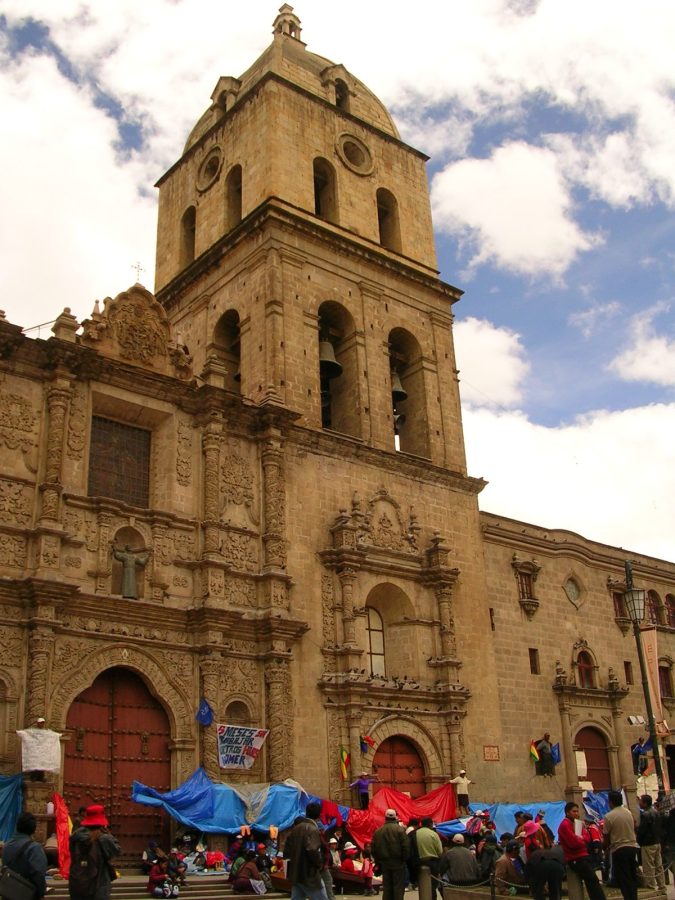
Photo: Elemaki, CC BY 3.0
The church is free to enter. The museum in the convent charges a modest ticket and includes a guided visit of the cloisters, the choir, the catacombs and the roof, which is the best thing on offer: the roof terrace looks over the Plaza San Francisco and the tin roofs climbing the sides of the canyon. Tours run hourly in Spanish and English.
Guided walking tours of La Paz include the basilica and cost several times that, usually adding the Witches' Market up the hill. The basilica is at the bottom of the old town where the city's two halves meet, on every bus and minibus route, so there is no transport problem. Nothing needs booking. Museum tickets are sold at a desk in the cloister entrance to the right of the church front.
Live prices from GetYourGuide for tours whose route includes this church. Free cancellation on most of them.
Franciscans founded a convent here in 1548, two years after the city; the first church collapsed under snow around 1610 and the present one was built between 1743 and 1772, with the single tower added in the 1880s. The facade is the reason to come. It is carved in the style now called Andean baroque or mestizo baroque, in which Spanish forms were cut by indigenous masons who filled them with local content: masks, birds, chinchillas, pinecones, and vegetation that belongs to the altiplano rather than to Europe.
Inside, the gilded retable and the choir stalls follow colonial convention. The square outside is the gathering place for protest marches, brass bands and Aymara traders, and the church stands at the exact point where the colonial city met the indigenous one. The catacombs beneath the church hold the remains of colonial-era benefactors, and the choir keeps a set of hand-copied antiphonaries on a rotating lectern. The single tower, added in the 1880s, can be climbed on the museum tour and gives the best view of the plaza and the Illimani peak beyond it.
The church opens daily from early morning to evening with masses through the day; the museum keeps shorter hours and closes on Sunday afternoons. La Paz sits between 3,200 and 4,000 metres and visitors should give themselves a day or two before climbing the museum stairs. The dry season from May to October has the clearest light on the facade.
The square is busy at all hours and demonstrations are frequent and usually good-natured. Dress modestly. Photography is allowed in the church and restricted in the museum. Allow ninety minutes with the museum. The Witches' Market and Calle Jaen with its colonial houses are both a short and very steep walk uphill. The plaza is the terminus of many of the city's marches and the cable car network has a station a few minutes away.
363 km away
The entrance fee is moderate by Peruvian standards and covers the whole walled complex;
7 tickets & tours
Yes. GetYourGuide sells tickets and guided tours whose route includes Basilica of San Francisco, La Paz; live prices are shown on this page.
The church opens daily from early morning to evening with masses through the day; the museum keeps shorter hours and closes on Sunday afternoons.
The church is free to enter.
Allow ninety minutes with the museum.
Basilica of San Francisco, La Paz was founded in 1743.
Basilica of San Francisco, La Paz is in La Paz, Bolivia. The map on this page shows the exact spot.