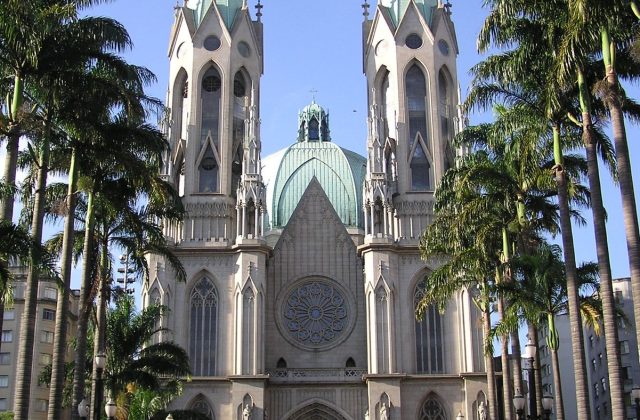
Sao Paulo Cathedral
Sao Paulo, Brazil
Entry to the cathedral is free. The crypt below, with the tombs of the archbishops and of the indigenous chief Tibirica…
1 ticket or tour

Photo: Photograph by Mike Peel (www.mikepeel.net)., CC BY-SA 4.0
Entry to the basilica and the crypt is free, as it must be for a shrine that receives around twelve million pilgrims a year. Paid extras are minor: a lift to the viewing gallery in the tower, a small museum of ex-votos and the panoramic chapel, each costing a token sum. Day trips from Sao Paulo cost a moderate amount and cover the two-hour drive each way along the Dutra highway; buses from Sao Paulo's Tiete terminal run hourly and are cheaper.
A cable car links the basilica to the older sanctuary on the hill and charges a small fare. Nothing needs booking except accommodation around 12 October, the national holiday. The complex has its own bus station, food halls and car parks, all built for crowds rather than for tourists. The shrine complex has a hotel, a hospital and a seminary attached, and the pilgrim infrastructure runs on a scale closer to an airport than a church.
Live dates and prices from GetYourGuide. Free cancellation on most tickets.
In 1717 three fishermen on the Paraiba river pulled up a headless clay statue of the Virgin, then the head, and then a catch so large it filled their boat; the figure, dark from years in the water, became Our Lady of Aparecida, patroness of Brazil. The present basilica was begun in 1955 to a Greek cross plan with four naves and a dome one hundred metres high, and it holds around 45,000 people, which makes it the largest Marian church in the world and second in size only to St Peter's.
The architecture is plain Romanesque revival brick, deliberately unshowy. The image itself, about forty centimetres tall and robed in embroidered blue, stands in a glass case above the altar, and pilgrims file past it on a moving walkway below, as they do in Mexico City. The bell tower carries a carillon of 365 bells and a lift to a gallery at one hundred metres, which gives the only view of the whole complex.
Open daily from early morning to late evening, with masses almost hourly and the walkway to the image running throughout. The 12th of October is the feast of Aparecida and a national holiday, when the city fills and the approach roads slow to walking pace; the days around it are equally busy. Weekends are heavier than weekdays year-round. The Paraiba valley is warm and humid in summer, from December to March. Dress is informal, as everywhere in Brazil, though pilgrims dress carefully.
Photography is allowed. Allow two hours, a full day from Sao Paulo. The older sanctuary on the hill, reached by the cable car, is a quieter building and is where the image was kept before 1980. The old basilica and the new one are linked by a covered walkway, and most pilgrims visit both in the same morning. Sao Paulo to Aparecida buses run every half hour and take about two hours, and the terminal sits inside the shrine complex itself.
Yes. GetYourGuide lists 2 tickets and tours for Basilica of Our Lady of Aparecida, with live dates and prices and free cancellation on most of them.
The basilica stands 100 m high.
Entry to the basilica and the crypt is free, as it must be for a shrine that receives around twelve million pilgrims a year.
Allow two hours, a full day from Sao Paulo.
Basilica of Our Lady of Aparecida was founded in 1955.
Basilica of Our Lady of Aparecida is in Sao Paulo, Brazil. The map on this page shows the exact spot.
Sao Paulo, Brazil
Entry to the cathedral is free. The crypt below, with the tombs of the archbishops and of the indigenous chief Tibirica…
1 ticket or tour