
Basílica del Voto Nacional
1 km away
Almost everyone who books something here is booking the climb rather than the church.
2 tickets & tours
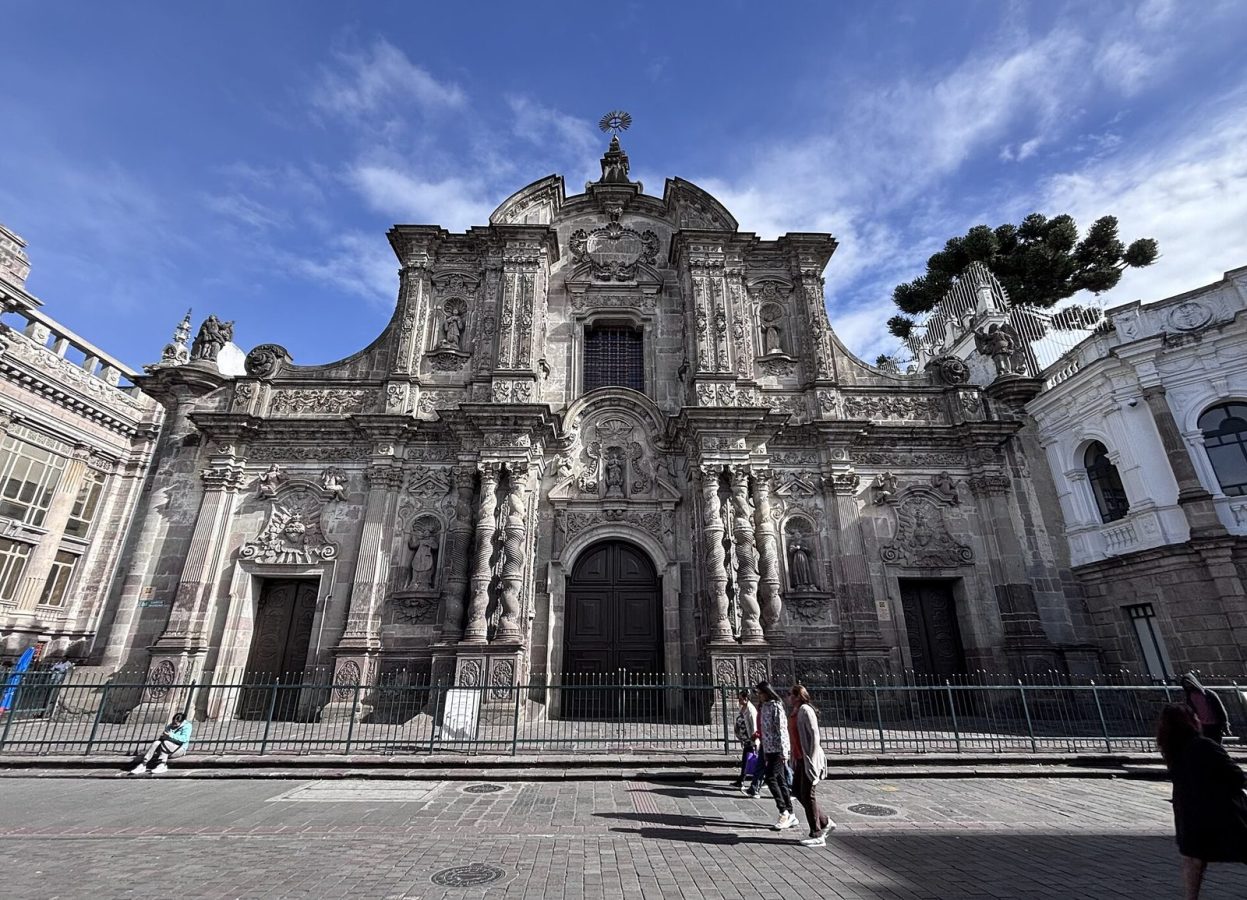
Photo: Ranoutofusername, CC BY-SA 4.0
La Compania charges admission and is worth every cent, but it is also one of the few churches in Quito with a proper ticketing operation, timed queues in season and a strict ban on photography inside. Buy at the door on the corner of the two streets it occupies. Guides are available at the entrance and are genuinely useful here, because the iconography is dense and the building's history spans a century and a half.
Almost every walking tour of the historic centre includes it, usually together with the Franciscan monastery and the main square, and half a day covers the three. Combined tickets with the neighbouring Jesuit buildings are sold at times. If you are choosing one interior in Quito, choose this one, and leave the basilica on the hill for the tower climb rather than for what is inside it. Guides at the door work in Spanish and English and charge a fixed rate posted at the ticket desk.
Live prices from GetYourGuide for tours whose route includes this church. Free cancellation on most of them.
Construction began in 1605 and continued for about a hundred and sixty years, which is why the church moves through several phases of the baroque without ever losing coherence. The front is carved entirely from grey volcanic stone, with six twisted Solomonic columns modelled on those of the baldachin in Rome, and the level of undercutting in the stone is extraordinary given the material. Inside, almost every surface is covered in gold leaf over carved and gilded wood, applied across vaults, arches, pulpit and altarpieces, so that the interior reads as a single continuous glow;
one eighteenth-century Jesuit called it a golden ember. The ceiling of the nave carries geometric patterns of Moorish derivation, brought by way of Spain, and indigenous motifs appear throughout the carving. Two large paintings of hell and the last judgement hang near the entrance, and the venerated image of Our Lady of Sorrows stands in its own chapel. Roughly seven tonnes of gold leaf are estimated to have gone into the interior, laid over cedar carved by local workshops.
Opening is through the day with a break at lunch and shorter hours at weekends, and the church closes for services. Mornings are calmer; tour groups concentrate between eleven and two. The gold needs light, and the interior is noticeably better on a bright day, which in Quito means the dry months from June to September. The historic centre is best visited in daylight and left by taxi after dark.
Holy Week is the great occasion here, with a procession of thousands of hooded penitents through the old town on Good Friday that starts at the Franciscan church nearby. The altitude of 2,850 metres makes even walking the cobbled streets harder than it looks, so plan fewer stops than you would elsewhere. Allow forty minutes inside, and take the guide if one is free. The Jesuit block around the church held a university and a seminary in colonial times, and parts of it can be seen from the street.
1 km away
Almost everyone who books something here is booking the climb rather than the church.
2 tickets & tours
Yes. GetYourGuide sells tickets and guided tours whose route includes Church of La Compañía, Quito; live prices are shown on this page.
Allow forty minutes inside, and take the guide if one is free.
Church of La Compañía, Quito was founded in 1605.
Church of La Compañía, Quito is in Quito, Ecuador. The map on this page shows the exact spot.
Quito, Ecuador
Almost everyone who books something here is booking the climb rather than the church.
2 tickets & tours